
Quick answer
Baht buses (songthaews) loop down Beach Road and back up Second Road, with branches to Jomtien and Naklua. Since 10 April 2026 the fare is 15 THB for rides up to 10 km and 20 THB beyond, paid to the driver when you get off. Bolt and Grab rides across town cost 60 to 250 THB, motorbike taxis 40 to 80 THB, and a scooter rents for 200 to 350 THB a day.
Pattaya is a long, narrow city. Beach Road and Second Road run parallel along the 3 km bay; Naklua continues north of the Dolphin Roundabout; Pratumnak Hill closes the bay to the south, and Jomtien's 6 km beach lies on the other side of the hill. Sukhumvit Road, the highway, runs behind it all, 2 to 3 km inland. Almost every trip a visitor makes follows one of these lines, which is why a fleet of blue pickup trucks does the work of a bus network.
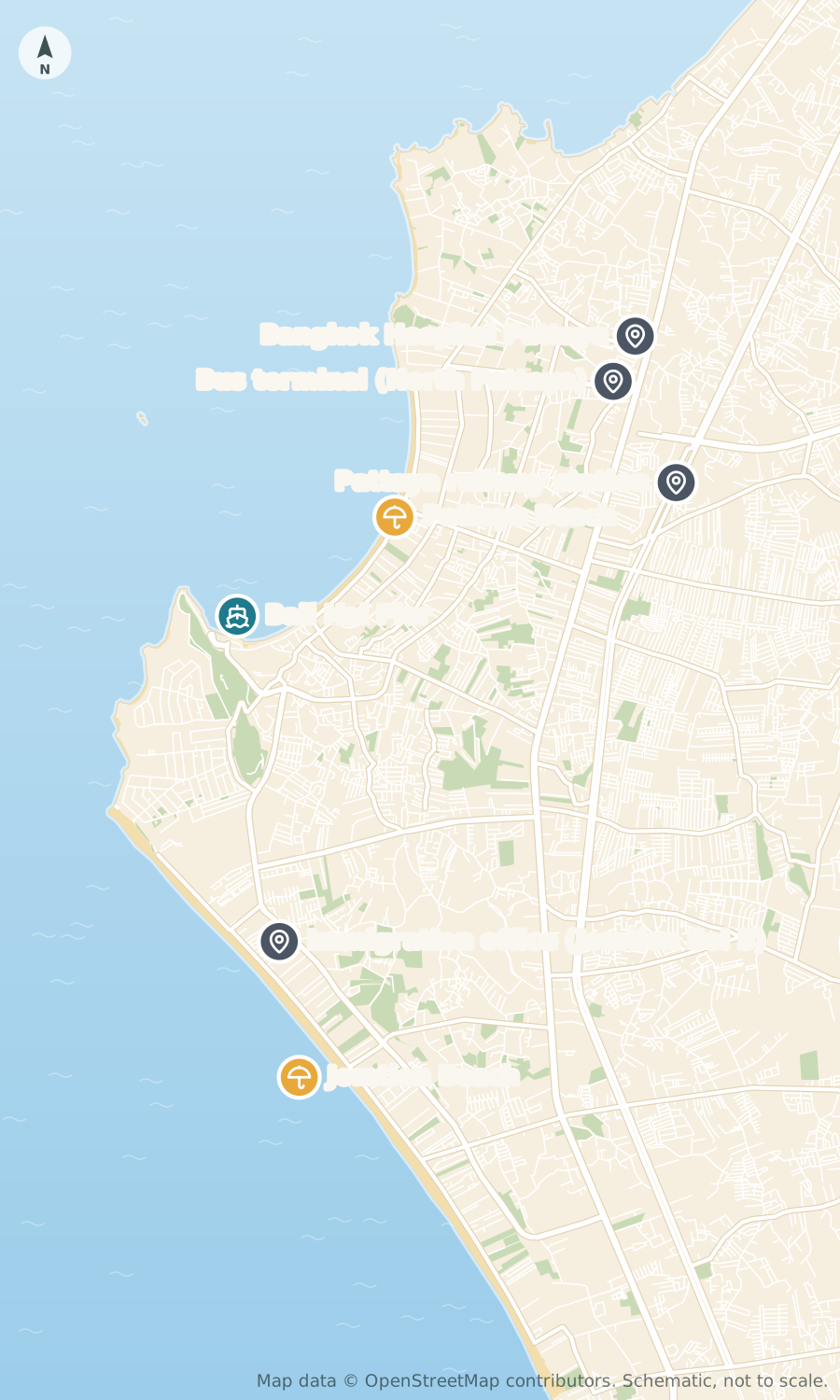
How do baht buses work in Pattaya?
A baht bus, or songthaew, is a dark-blue pickup with two benches and a roof over the back. Hundreds of them circulate from early morning until about midnight, thinning out after 22:00. There are no numbers, timetables or marked stops: the trucks follow fixed streets, and you use them like a moving walkway.
- Stand on the side of the road where traffic goes your way and raise a hand at a truck that is already moving. Climb in at the back without speaking to the driver.
- Follow your position on a phone map. Nobody announces stops.
- Press the buzzer on the ceiling or the rail when you want to get off. The truck pulls over within a few metres.
- Walk round to the driver's window and pay in cash: 15 THB per person, 20 THB on the longer runs.
The fare rose on 10 April 2026 from the 10 THB it had been for some 30 years. The operators' cooperative set it at 15 THB for trips of up to 10 km and a maximum of 20 THB beyond. Carry coins and 20 THB notes: drivers rarely have change for a 500 or a 1,000.
The one rule that saves money: do not ask the price and do not name a destination before boarding. A parked truck whose driver calls you over, or any truck you negotiate with through the window, becomes a private charter at 100 to 300 THB for the same ride. Chartering is fine when you want it, for a group with luggage or a trip off the routes, but agree the total for the vehicle first.
Which routes do the baht buses follow?
| Route | Where it runs | Fare (THB) |
|---|---|---|
| Beach Road and Second Road loop | One way south along Beach Road from the Dolphin Roundabout to Walking Street, then one way north up Second Road past the malls and back to the roundabout | 15 |
| Pattaya to Jomtien | From the corner of Second Road and South Pattaya Road, over Thappraya Road, then the length of Jomtien Beach Road | 15 to 20 |
| Pattaya to Naklua | From the Dolphin Roundabout north along Pattaya-Naklua Road to Naklua market | 15 |
| Cross streets | North, Central and South Pattaya Roads between the beach and Sukhumvit Road | 15 |
Because Beach Road and Second Road are both one way, a trip often means riding around the loop: to go north from Walking Street, walk one block inland to Second Road. To reach Jomtien from North or Central Pattaya, ride the loop to South Pattaya Road, get off, pay, and board a Jomtien truck at the corner. Nothing useful runs into the small sois, up Pratumnak Hill or east of Sukhumvit Road, which is where the other options come in.
For what each district is like once you get there, see the area guides to Jomtien and Naklua and Wongamat.
How much are Bolt, Grab and taxis in Pattaya?
Ride apps are the simple answer for anything off the songthaew lines, for late evenings and for trips with children or shopping. Bolt and Grab are the two big ones; Maxim and inDrive also operate. The price appears before you confirm, the route is tracked and you can pay in cash or by card. You need mobile data, so pick up a tourist SIM or eSIM at the airport.
| Transport | Typical fare (THB) | Notes |
|---|---|---|
| Baht bus on a fixed route | 15 to 20 per person | Cash to the driver on leaving |
| Chartered baht bus | 100 to 300 per vehicle | Agreed before boarding |
| Motorbike taxi, short hop | 40 to 80 | One passenger; agree the fare first |
| Bolt, short ride in the centre | 60 to 120 | Usually a little under Grab |
| Grab, short ride in the centre | 80 to 150 | Prices rise in heavy rain |
| App ride, Central Pattaya to Jomtien | 150 to 250 | 20 to 30 minutes |
| Taxi hailed in the street | 100 to 400 | Insist on the meter or agree a price |
| Scooter rental, 110 to 160 cc | 200 to 350 per day | 1,200 to 2,200 per week |
| Economy car rental | 600 to 1,200 per day | Insurance excess varies |
The blue-and-yellow taxis parked near malls and big hotels carry meters, but many drivers quote a flat price that is higher than the apps. Take them on the meter or by agreed fare, never on a vague promise. Motorbike taxi riders wear numbered coloured vests and wait at stands at the mouth of most sois. They are quick for one person on a short trip; the rider must hand you a helmet, and you should wear it.
Should you rent a scooter or a car in Pattaya?
A scooter is the cheapest way to have your own wheels, and the cause of most visitor injuries. Rent one only if you already ride at home. The practical facts:
- Licence: Thai law requires a licence valid for motorcycles. For a visitor that means your home licence with a motorcycle category plus an International Driving Permit that also shows it. A car licence does not cover a scooter of any size.
- Helmet: compulsory for rider and passenger. Since 1 June 2025 the fine is up to 2,000 THB, and police checkpoints on the main roads are frequent.
- Insurance: the compulsory cover that comes with the bike pays only small medical sums for injured people. Damage, theft and serious treatment fall on you or your travel insurer, and most travel policies refuse claims from riders without the right licence or helmet.
- Deposit: leave cash or a photocopy of your passport, never the passport itself. Film the whole bike, including scratches and the fuel gauge, before you ride off.
- Traffic drives on the left. Do not ride after drinking.
A car makes sense for day trips rather than for the city, where parking near the beach is scarce. International and Thai rental firms have desks in town and at the airports; you need your licence, an International Driving Permit and a credit card for the deposit. The Department of Land Transport is the official source for licence rules.
Rental disputes and how to avoid them are covered in scams and safety in Pattaya.
Can you get around Pattaya on foot?
Within a district, yes. The Beach Road promenade runs about 3 km from the Dolphin Roundabout to Walking Street, shaded by trees and rebuilt with a wide footpath; end to end it takes 40 minutes. Second Road, one block inland, strings together the malls. Jomtien has a similar beachfront path.
- Walk early or after 17:00. Midday temperatures of 30 to 35°C make anything over 15 minutes hard work.
- Pavements in the sois are uneven and often blocked. Wear closed sandals or trainers, not flip-flops.
- Cross at the signal-controlled crossings on Beach Road and Second Road and wait for traffic to stop: motorbikes do not always give way.
- Between districts, such as the centre to Jomtien or Naklua, distances are 4 to 8 km: ride.
How do you get to the Koh Larn ferry?
Ferries to Koh Larn leave from Bali Hai Pier, at the far southern end of Walking Street. The public ferry costs 40 THB each way since 10 April 2026 and takes about 45 minutes; speedboats from the same pier and from the beach cost more and cross in about 15 minutes. Life jackets are on board: wear one.
To reach the pier, ride the Beach Road songthaew to its last stop at the Walking Street entrance and walk 10 to 15 minutes, or take an app ride straight to the pier car park for 60 to 150 THB from most of the city. Allow extra time on weekends, when the queue for the morning boats is long.
Timetables, beaches and island transport are in the Koh Larn guide. If you are arriving from Bangkok, the stops used by the airport buses are explained in Bangkok airports to Pattaya.
Frequently asked
- Is the Pattaya baht bus still 10 baht?
- No. The fare went up on 10 April 2026, the first increase in about 30 years. It is now 15 THB per person for rides of up to 10 km, which covers the Beach Road and Second Road loop and the Naklua run, and up to 20 THB for longer routes. Many older guides and maps still quote 10 THB, so have a 20 THB note ready and expect 5 THB change.
- Do baht buses run at night?
- The Beach Road and Second Road loop runs until about midnight, with fewer trucks after 22:00. The Jomtien and Naklua branches thin out earlier in the evening, and late drivers often work only as charters at 100 THB or more. After a show or a late dinner, an app ride is quicker and usually costs 80 to 200 THB to anywhere in the city, with the price fixed before you get in.
- Who do you call if something goes wrong on the road?
- The Tourist Police answer in English on 1155, around the clock. For an ambulance dial 1669. For a dispute over a fare, note the vehicle's number: baht buses and motorbike taxi vests carry one, and app rides are logged in your trip history, which lets you report the driver through the app. After a rental accident, call the shop and the Tourist Police before agreeing to any payment.


